Blackjack Online: How to Play, Choose a Casino, and Claim the Best Offer
Last updated: June 2026

Last updated: June 2026
Blackjack is a card game with one clear objective: beat the dealer. Not other players. Just the dealer. You build a hand as close to 21 as possible without going over, and if your total is higher than the dealer's total, you win. Simple enough on the surface, but there is genuine depth underneath.
This game holds a unique position in the iGaming ecosystem. In 2024, 42% of online casino users in the United States preferred blackjack over other table games, citing its low risk profile and strategic depth as primary reasons (EY Gaming Report, 2024). That preference is not accidental. Two things set blackjack apart from most casino games:
First, the house edge is remarkably low. When played with optimal strategy, the casino's mathematical advantage drops to roughly 0.5%, far below slots (2 to 10%) or roulette (2.7 to 5.26%), according to the American Gaming Association, 2023.
Second, every hand presents a real decision. Hit, stand, double, split. Each choice directly influences your expected return. That blend of luck and skill is what keeps both beginners and experienced players coming back.
Online blackjack amplifies these advantages in practical ways. Digital platforms offer 24/7 access, micro-limits starting at $0.10 per hand (versus the typical $5 to $10 minimum in physical casinos), and an interface that makes decision points explicit. Free-play demo modes, standard on most online casinos, let newcomers learn the rules without risking money. No brick-and-mortar casino can afford to offer that due to table occupancy costs.
The target is 21. Or more precisely, getting closer to 21 than the dealer without exceeding it.
You receive two cards to start. The dealer also gets two cards, one face-up and one face-down. From there, you decide whether to take more cards or stop. A player can win in three ways: by receiving a natural blackjack (an Ace plus a 10-value card totalling exactly 21) when the dealer does not, by finishing with a higher total than the dealer, or by the dealer busting, meaning they exceed 21.
A natural blackjack is the strongest possible opening hand. It typically pays 3:2 at a fair table. That means a $10 bet returns $25 total. If both you and the dealer have blackjack, it is a push and your bet is returned.
"A DQN agent trained with a curriculum learning approach raised its win rate from 43.97% to 47.41% and reduced its bust rate from 32.9% to 28.0% under eight-deck conditions, illustrating that structured learning yields measurable improvements even for non-human learners." - Learning to Play Blackjack: A Curriculum Learning Perspective, arXiv preprint, 2026.
Access matters. You can play blackjack online at 3 AM from your phone, or during a lunch break on a laptop. The range of blackjack games available on a single platform often exceeds what you would find in a mid-sized physical casino. Classic, European, Atlantic City, Single Deck, and more, all a click away.
For newcomers, free blackjack is the obvious starting point. You learn the mechanics, test decisions, and build confidence without financial pressure. For experienced players, live blackjack delivers the table atmosphere of a real casino, complete with a human dealer streamed in HD. And for everyone in between, real money tables at low stakes offer a gradual transition.
That flexibility is a big part of why online blackjack casino formats keep growing. You pick the format that matches your goal, whether that is learning, entertainment, or serious play.
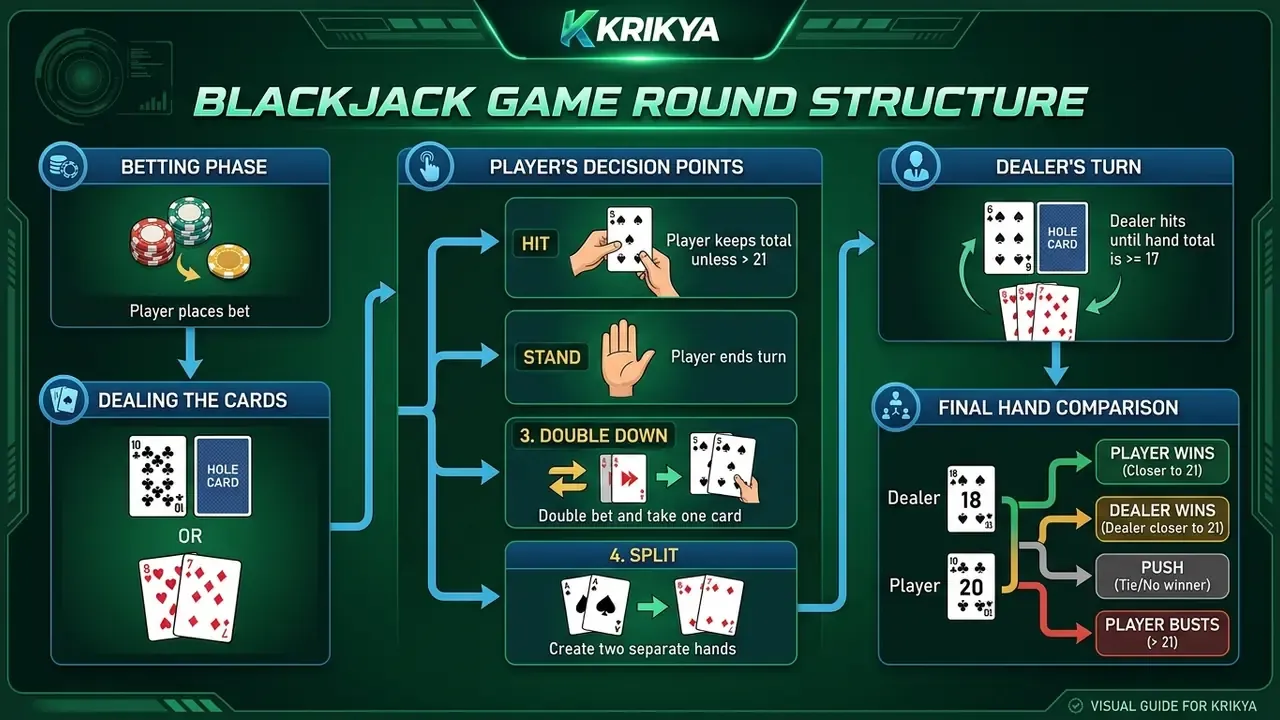
A classic round of blackjack follows five clear phases: bet, deal, player decisions, dealer play, settlement. Once you memorize this sequence, you already understand the skeleton of every variant. Let me walk through it.
Before any cards appear, select a chip value in the interface and click the betting area. Online tables accept stakes from as low as $0.10 on RNG tables to $10,000 or more on live VIP tables. Set a session budget before you begin. Never bet more than you can afford to lose.
The dealer then gives you two cards face-up and takes two cards for themselves. One of the dealer's cards is face-up (the upcard) and one is face-down (the hole card). The upcard is the single most important piece of information you will use to guide every subsequent decision.
Worth noting: in online environments, no single government or ISO standard regulates how cards are distributed. Rules are set by individual software providers like Evolution Gaming or Playtech and verified by jurisdictional licenses such as the UK Gambling Commission or Malta Gaming Authority (UKGC, 2023).
Based on your two cards and the dealer's upcard, you choose one of the following actions:
| Action | What Happens | When to Consider |
|---|---|---|
| Hit | You receive one additional card. | Your total is low (generally 11 or less) and there is no risk of busting. |
| Stand | You keep your current total. | Your total is strong (generally 17 or more) or the dealer's upcard is weak. |
| Double Down | Your bet doubles; you receive exactly one more card, then your turn ends. | You hold 10 or 11 and the dealer shows a weak upcard. |
| Split | A pair is separated into two independent hands, each with its own bet. | You have a pair of Aces or 8s (always split); never split 10s, 5s, or 4s. |
| Surrender (if available) | You forfeit half your bet and end the hand immediately. | You have Hard 16 against a dealer 10 or Ace. Reduces house edge by roughly 0.10%. |
One quick note on Insurance. This side bet is offered when the dealer shows an Ace. It has a house edge of roughly 7% and is mathematically unprofitable in the long run. Skip it.
Once every player has acted, the dealer reveals the hole card. The dealer's rules are fixed and non-negotiable:
Some variants require the dealer to hit on soft 17 (a hand containing an Ace counted as 11). This single rule change raises the house edge by approximately 0.2%, so check the table rules before you sit down.
Here is how the round resolves:
| Outcome | What Happens |
|---|---|
| Player wins | Your total is higher than the dealer's without exceeding 21, or the dealer busts. Standard payout: 1:1. |
| Natural Blackjack | Your first two cards total exactly 21 (Ace plus 10-value card). Standard payout: 3:2. Avoid any table that pays 6:5. That single rule change adds 1.39% to the house edge. |
| Push (Tie) | Your total equals the dealer's. Your bet is returned. |
| Player loses | Your total is lower, or you bust (exceed 21). You lose your bet. |
Because the dealer must hit low totals, certain upcards are particularly weak. When the dealer shows 4, 5, or 6, their bust probability exceeds 40%. In these situations, you should often stand on lower totals and let the dealer take the risk.
| Dealer Upcard | Approximate Bust Probability |
|---|---|
| 2 | 35% |
| 3 | 37% |
| 4 | 40% |
| 5 | 42% |
| 6 | 42% |
| 7 | 26% |
| 8 | 24% |
| 9 | 23% |
| 10/Face | 23% |
| Ace | 17% |
"A 2023 technical analysis confirmed that continuous shuffling machines generate card sequences sufficiently close to random to prevent counting in practical casino conditions." - Stochastic modeling of casino shuffling machines, 2023.
Understanding the difference between "hard" and "soft" hands is, honestly, the single most important concept for correct decision-making. Everything else builds on it.
| Card | Value |
|---|---|
| 2 through 9 | Face value |
| 10, Jack, Queen, King | 10 |
| Ace | 1 or 11 (whichever benefits you most) |
A soft hand contains an Ace counted as 11 without exceeding 21. Example: Ace plus 6 equals Soft 17. You can safely hit because if you draw a high card, the Ace reverts to 1 and you cannot bust.
A hard hand either contains no Ace, or the Ace must count as 1 to avoid busting. Example: 10 plus 7 equals Hard 17. Hitting is risky because any card above 4 causes a bust.
Here are more examples to build intuition:
| Hand | Type | Total | Why It Matters |
|---|---|---|---|
| Ace + 3 | Soft 14 | 14 (or 4) | Very safe to hit; almost no bust risk. |
| Ace + 8 | Soft 19 | 19 | Strong hand; almost always stand. |
| 10 + 6 | Hard 16 | 16 | The worst position: hitting risks bust, standing hopes the dealer busts. |
| Ace + 5 + 10 | Hard 16 | 16 | The Ace has reverted to 1; this is now a hard hand. |
This distinction matters because basic strategy prescribes different actions for the same numeric total depending on whether the hand is hard or soft. For instance, you should almost always hit on Soft 17 but stand on Hard 17.
Field data show that players under-use the advantage of soft hands, standing too often on totals that could safely absorb an additional card. - Las Vegas Blackjack Field Study.
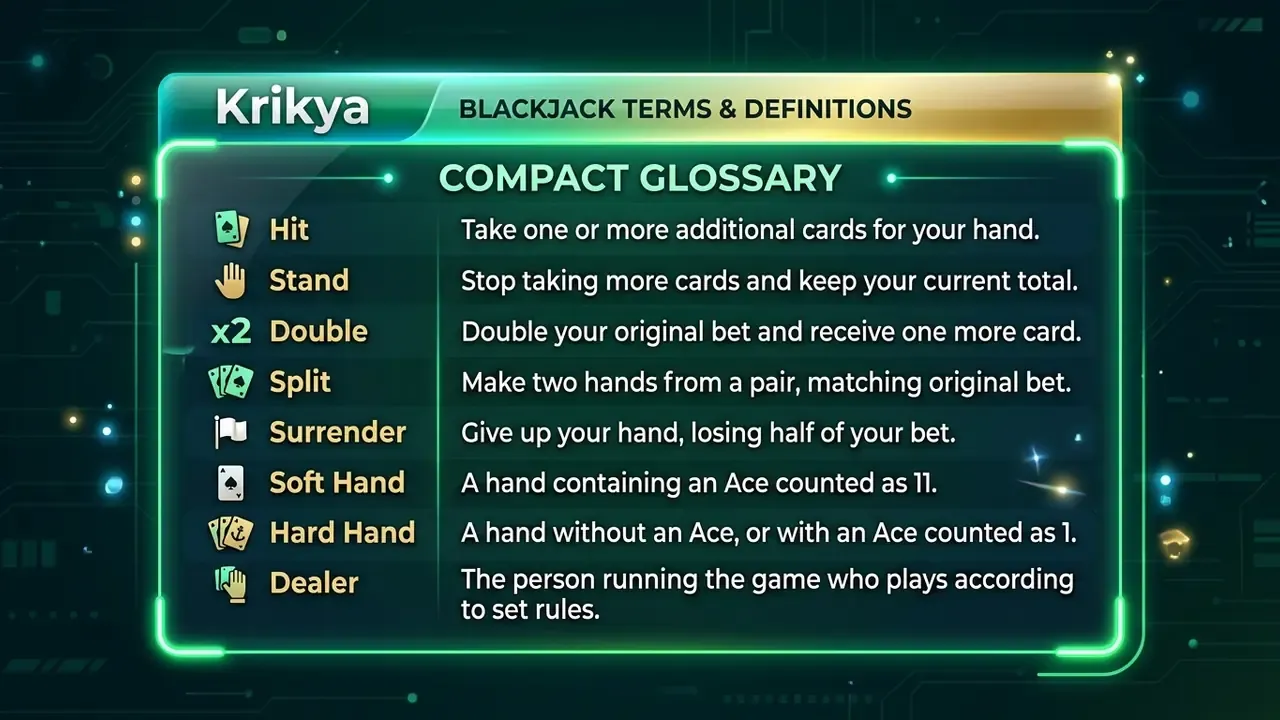
| Term | Definition |
|---|---|
| Hit | Request an additional card from the dealer. |
| Stand | Refuse further cards and end your turn. |
| Double Down | Double your initial bet in exchange for exactly one more card. |
| Split | Separate a pair of identical cards into two independent hands, each with its own bet. |
| Surrender | Forfeit your hand and recover half your bet. Available in some variants only. |
| Soft Hand | A hand containing an Ace counted as 11 without exceeding 21 (e.g., Ace + 6 = Soft 17). |
| Hard Hand | A hand where the Ace must count as 1 to avoid busting, or no Ace is present (e.g., 10 + 7 = Hard 17). |
| Bust | Exceeding 21, resulting in an automatic loss. |
| Push | A tie between player and dealer; the bet is returned. |
| Natural Blackjack | A two-card hand totalling exactly 21 (Ace + 10-value card). Standard payout: 3:2. |
| Upcard | The dealer's visible card. |
| Hole Card | The dealer's face-down card. |
| Insurance | A side bet offered when the dealer shows an Ace, paying 2:1 if the dealer has blackjack. House edge: roughly 7%. |
| Shoe | The device holding multiple decks from which cards are dealt. |
| CSM | Continuous Shuffling Machine. Returns discards to the shoe after every few hands, preventing card counting. |
| RNG | Random Number Generator. The algorithm producing random card sequences in digital blackjack. |
| House Edge | The casino's statistical advantage, expressed as a percentage of each bet. |
| RTP | Return to Player. The theoretical percentage of wagered money returned to players over time (100% minus the house edge). |
| Wagering Requirement | The number of times a bonus must be bet before withdrawal is permitted. |
Not all blackjack games are created equal. The variant you choose directly affects the house edge, the pace, and honestly, how much fun you have. Let me break down the main formats and the specific variants worth knowing.
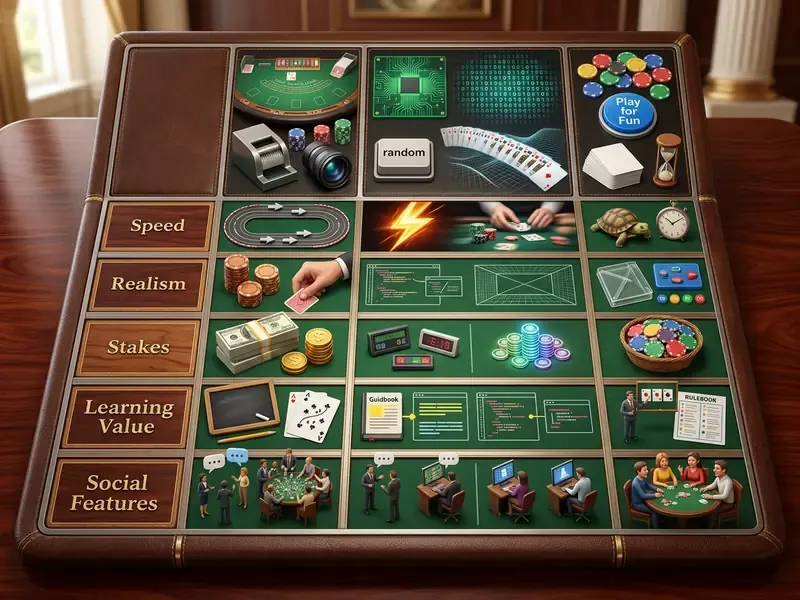
| Feature | RNG Blackjack | Live Blackjack | Free / Demo |
|---|---|---|---|
| Speed | 200+ hands/hour | 50 to 60 hands/hour | Unlimited |
| Realism | Computer graphics | HD/4K video, real dealer | Computer graphics |
| Minimum Stake | $0.10 | $5 to $10 | $0 (virtual chips) |
| Maximum Stake | Roughly $500 to $5,000 | Up to $10,000 to $50,000 | N/A |
| Social Features | None | Chat with dealer/players | None |
| Card Counting Viable? | No (virtual shuffle per hand) | Extremely difficult (CSMs + 8 decks) | No |
| Best For | Strategy drilling, low-stakes play | Atmosphere, high-stakes sessions | Learning rules |
RNG tables use a certified random number generator (per ISO/IEC 27001 standards) that virtually reshuffles the deck after every hand. Outcomes are instant, typically resolved in under two seconds. This format is ideal for players who want to practice basic strategy at high volume without social pressure.
Live blackjack streams a real human dealer from a licensed studio. Video latency is typically 3 to 5 seconds. The experience is significantly more immersive. You see physical cards being dealt, albeit with the psychological comfort of playing from home. Live tables generally have higher minimum bets and slower pace, making them better suited to experienced players or those who enjoy the social element.
"Practical implementations of shuffling machines in major casinos produce card sequences sufficiently close to random to prevent card counting." - Stochastic modeling of casino shuffling machines, 2023.
Free (demo) blackjack is available on most online casino platforms and uses the same RNG engine as real-money tables. The core mechanics are identical: same card values, same dealer rules, same decision points. This makes it an excellent tool for learning the rules without financial risk, practicing basic strategy until it becomes automatic, and testing new variants before committing real money.
However, free play has critical limitations. Without real money at stake, you will take risks you would never take otherwise. Research confirms that participants make fundamentally different risk decisions when outcomes are hypothetical versus financially meaningful (Bayesian gambling experiments). Virtual chips are unlimited and non-transferable, so you cannot practice stop-loss discipline or session budgeting.
And free play does not replicate wagering requirements, blackjack contribution percentages, or withdrawal limits.
A study by the University of Nevada, Las Vegas found that free-play promotions have a diminishing marginal effect on player engagement with repeated use, suggesting that the motivational boost of "free money" wears off over time (UNLV Free-Play Promotion Study).
"The 2024 Online Problem Gaming Behavior Index found that frequency of play, session duration, and loss-chasing are closely associated with elevated risk scores." - Online Problem Gaming Behavior Index, 2024.
Players transitioning from free to real-money blackjack should set firm deposit limits, start at the lowest available stakes, and treat their initial sessions as an extension of training, not as an opportunity to "make money."
Here is where things get interesting. The variant you pick directly affects the house edge, from as low as 0.17% (Single Deck) to as high as 9.0% (Double Exposure).
Classic / American Blackjack. The standard game uses 6 to 8 decks, the dealer peeks for blackjack, and a natural pays 3:2. House edge: roughly 0.5% with basic strategy.
European Blackjack. The dealer does not peek for blackjack, meaning you can lose your double or split bets if the dealer later reveals a natural. House edge: roughly 0.62%. Players can double down after a split.
Atlantic City Blackjack. Uses eight decks, the dealer stands on all 17s, and late surrender is available. One of the most player-friendly rulesets. House edge: 0.36%.
Single Deck Blackjack. Played with one 52-card deck. Fewer decks improve the player's odds because the probability of natural blackjack increases. House edge: as low as 0.17% (Wizard of Odds, 2023), provided the game pays 3:2 for a natural. Many casinos offset this by paying only 6:5, which erases the advantage entirely.
Blackjack Switch. You receive two hands and may swap the top cards between them. The trade-off: a dealer hard 22 is a push (not a bust), and natural blackjack pays only 1:1. House edge: roughly 0.58% with optimal strategy.
Spanish 21. All 10-cards are removed from the deck, but bonus payouts for specific combinations (like 5-6-7 or 7-7-7) partially compensate. House edge: roughly 0.78% (Wizard of Odds, 2023).
Double Exposure Blackjack. Both dealer cards are face-up, a massive informational advantage. The casino compensates by making ties a dealer win and reducing the blackjack payout to 1:1. House edge: up to 9.0%, making it the least favorable common variant (Wizard of Odds, 2023).
Perfect Pairs Blackjack. Adds optional side bets on whether your first two cards form a mixed pair, colour pair, or perfect pair. The base game retains standard house edge, but side bets typically carry a much higher edge (2 to 6%).
| Variant | Decks | Key Rule Difference | House Edge (Basic Strategy) |
|---|---|---|---|
| Single Deck (3:2) | 1 | Fewer decks, higher natural BJ probability | ~0.17% |
| Atlantic City | 8 | Dealer stands all 17s, late surrender | ~0.36% |
| Classic 6-Deck | 6 | Standard rules, 3:2 payout | ~0.50% |
| Blackjack Switch | 6 to 8 | Swap cards between two hands | ~0.58% |
| European | 2 | No peek, no surrender | ~0.62% |
| Spanish 21 | 6 to 8 | No 10-cards, bonus payouts | ~0.78% |
| Single Deck (6:5) | 1 | Reduced payout for naturals | ~1.56% |
| Double Exposure | 6 to 8 | Both dealer cards visible | ~9.00% |
Critical warning: A table paying 6:5 instead of 3:2 adds exactly 1.39% to the house edge (Wizard of Odds, 2024; American Casino Guide, 2023; Blackjack Forum, 2024). This is the single most damaging rule change in modern blackjack. Always verify the payout before placing your first bet.
Basic strategy is a mathematically derived set of decisions for every possible player hand versus dealer upcard combination. Following it consistently reduces the house edge from roughly 2% (intuitive play) to roughly 0.5%. That is not a small difference. Over 1,000 hands at $10 per hand, it is the difference between an expected loss of $50 and an expected loss of $200.
Edward Thorp's 1962 book Beat the Dealer first proved mathematically that a fixed set of optimal decisions could dramatically reduce the casino's advantage. Modern computer simulations, running billions of hands, have refined these recommendations to account for specific rule variations.
| Play Style | Approximate House Edge |
|---|---|
| Pure intuition / gut feeling | ~2.0% |
| Basic strategy (dealer stands soft 17) | ~0.50% |
| Basic strategy (dealer hits soft 17) | ~0.65% |
| Deviating 1% from basic strategy | ~0.65% |
Source: Beat the Dealer, Thorp, 1962; Blackjack Forum simulations, 2023; Nevada Gaming Control Board report, 2021.
"Theoretical models from 2024 confirm that the optimal hit-or-stand strategy is computable for every combination of player hand and dealer upcard." - Basic Strategy for Simplified Blackjack Variants, arXiv preprint, July 2024.
The core principles are straightforward:
Here is a quick-reference chart for hard totals:
| Your Hand | Dealer 2-3 | Dealer 4-6 | Dealer 7-9 | Dealer 10 | Dealer Ace |
|---|---|---|---|---|---|
| 8 or less | Hit | Hit | Hit | Hit | Hit |
| 9 | Hit | Double | Hit | Hit | Hit |
| 10 | Double | Double | Double | Double | Hit |
| 11 | Double | Double | Double | Double | Double |
| 12 | Hit | Stand | Hit | Hit | Hit |
| 13-16 | Stand | Stand | Hit | Hit | Hit |
| 17+ | Stand | Stand | Stand | Stand | Stand |
Note: This table assumes standard 6-deck rules where the dealer stands on soft 17. Adjust for specific variants.
Research from a Las Vegas blackjack field study found that errors of omission, failing to hit when hitting is mathematically optimal, were four times more common than errors of commission. Players instinctively avoid the risk of busting, even when standing guarantees a worse expected value.
"Participants in Bayesian gambling experiments systematically undervalued the expected value of risky actions and overvalued the safety of conservative choices." - Experimental research on Bayesian gambling tasks.
This pattern, known as loss aversion, directly contradicts what the math recommends. Online platforms make overriding these instincts easier by displaying your total, the dealer's upcard, and the available actions simultaneously, reducing the cognitive load.
Knowing what to do with five critical hands covers a disproportionate share of the decisions you will face at the table.
| Your Hand | Dealer Upcard | Optimal Play | Why |
|---|---|---|---|
| Natural 21 (Ace + 10) | Any | Stand (automatic win unless dealer also has 21) | The strongest possible hand. Pays 3:2 at a fair table. |
| 11 (e.g., 8 + 3) | Dealer 5 | Double Down | Highest probability of reaching 20 or 21 with one card. |
| Hard 16 (e.g., 10 + 6) | Dealer 10 | Stand (or surrender if available) | Hitting yields a roughly 62% bust probability; standing or surrendering minimizes expected loss. |
| Pair of 8s | Dealer 6 | Split | 16 is the worst total; two fresh hands starting at 8 each have much better expected value. |
| Hard 12 | Dealer 3 | Hit | The dealer's moderate bust probability makes improving your hand the higher-EV play. |
"A curriculum-trained agent achieved expert-level win rates under eight-deck conditions by gradually mastering doubling and splitting after first learning hit-and-stand decisions." - Learning to Play Blackjack: A Curriculum Learning Perspective, arXiv preprint, 2026.
The "Soft 18" Trap. Soft 18 (Ace + 7) is one of the most misplayed hands in blackjack. Against a dealer 9, 10, or Ace, hitting is correct. You cannot bust (the Ace reverts to 1), and 18 frequently loses to these strong dealer upcards. Most recreational players stand here, costing themselves significant expected value over time.
Card counting is a legitimate and legal technique in physical casinos with shoe-dealt games. But it is mathematically ineffective in online blackjack due to continuous virtual shuffling.
Why counting does not work online. Online RNG blackjack virtually reshuffles the entire deck after every single hand. There is no "shoe" to deplete, no running count to maintain, and no true count to calculate. The probability of any given card appearing remains constant on every hand.
Live dealer blackjack uses physical cards, but most studios employ Continuous Shuffling Machines (CSMs) that return discards to the shoe after every few hands, or use 8-deck shoes with frequent shuffles.
A 2023 stochastic analysis confirmed that these machines produce sequences sufficiently close to random, rendering counting practically unexploitable (Stochastic modeling of casino shuffling machines, 2023).
Mathematician Michael Shackleford (the "Wizard of Odds") has stated explicitly that card counting fails in online casinos because virtual decks are reshuffled after every hand, eliminating the pattern-tracking that counting requires (Wizard of Odds, 2022).
Common myths debunked:
| Myth | Reality |
|---|---|
| "Online blackjack is rigged" | Licensed platforms use RNG engines certified by independent auditors (eCOGRA, iTech Labs, GLI) under standards like ISO/IEC 27001 and NIST SP 800-22. |
| "The casino adjusts the RNG when you're winning" | RNG outcomes are determined by seed values generated before each hand. The casino cannot alter mid-hand results without failing its audit. |
| "You should always follow your gut" | Intuitive play results in a roughly 2% house edge vs. roughly 0.5% with basic strategy. |
| "Card counting works online" | Virtual shuffling after every hand eliminates the statistical memory counting depends on. |
| "Free blackjack prepares you fully for real money tables" | Free play teaches mechanics, but without real stakes, your risk decisions will differ. Treat it as training, not a predictor of real-money results. |
"Cognitive biases in gambling include attributing losses to external manipulation and wins to personal skill, which fuels distrust of RNG systems." - Experimental research on Bayesian gambling tasks.
The Hi-Lo Method (for physical casinos only). For completeness, here is the basic Hi-Lo counting system. Assign values: cards 2 through 6 equal +1; cards 7 through 9 equal 0; cards 10 through Ace equal -1. Maintain a running count from the start of the shoe. Calculate the true count by dividing the running count by estimated decks remaining. Raise your bet proportionally when the true count is positive (the remaining shoe favors the player). Remember: this technique is irrelevant for online play and extremely difficult even in live casinos using CSMs.
A reliable blackjack casino is licensed, audited, offers multiple variants with 3:2 payouts, processes withdrawals promptly, and clearly discloses all bonus terms. That sounds obvious, but you would be surprised how many players skip these checks.
Use this checklist to evaluate any licensed online casino before depositing real money:
| # | Question | What to Look For |
|---|---|---|
| 1 | Is the casino licensed? | Look for UKGC, MGA, Gibraltar, Curacao, or a US state-level license (e.g., NJ DGE). The license number should be displayed in the site footer. |
| 2 | Are games independently audited? | Logos from eCOGRA, iTech Labs, or GLI confirm that RNG and RTP are tested regularly. |
| 3 | Does it use SSL encryption? | The URL should begin with "https" and use 256-bit encryption (NIST SP 800-52 Rev. 2 compliance). |
| 4 | Are player funds segregated? | Reputable casinos hold player deposits in separate accounts from operational funds. |
| 5 | What blackjack variants are available? | Look for Classic, European, Atlantic City, and Single Deck options, all with 3:2 payouts. |
| 6 | How fast are withdrawals? | Crypto withdrawals should process within 1 to 2 hours; e-wallets within 24 hours. Ask support before depositing. |
| 7 | What is the blackjack contribution to wagering? | Standard: 5 to 10%. If it is 0%, the bonus has no value for blackjack players. |
| 8 | Is there live dealer availability? | Check whether the casino offers live blackjack tables from reputable providers like Evolution Gaming. |
| 9 | How does the mobile experience perform? | In 2026, any reputable platform runs on HTML5 and should load within 2 seconds on a mobile connection (W3C Mobile Web Best Practices, 2023). Dedicated iOS/Android apps are a bonus but not a requirement. |
Software providers as quality indicators. While no regulator officially designates certain providers as "quality markers," the presence of Evolution Gaming (live dealer) and Playtech or Microgaming (RNG) in a casino's lobby strongly correlates with regulatory compliance, because these providers only license their software to operators with valid gambling licenses.

Casino bonuses look generous but come with wagering requirements that can erase their value for blackjack players. Always read the fine print.
A "100% match bonus up to $500" with a 25x wagering requirement means you must wager $12,500 ($500 times 25) before you can withdraw bonus funds. If blackjack contributes only 5% toward wagering, as is common at major casinos, you would need to wager $250,000 at the blackjack table to clear the bonus.
| Casino (Example) | BJ Contribution to Wagering | Effective Wagering for $500 Bonus |
|---|---|---|
| Casino A (5%) | 5% | $250,000 |
| Casino B (10%) | 10% | $125,000 |
| Casino C (0%) | 0% | Bonus cannot be cleared at BJ tables |
"Free-play promotions may increase engagement initially, but repeated exposure leads to habituation and diminishing marginal effect." - UNLV Free-Play Promotion Study.
Loyalty and VIP programs. Loyalty programs return a fraction of your losses through comp points or cashback. Typical rates for blackjack range from 0.1% to 0.5% rakeback. While this can soften the house edge slightly, the net expected value for the player remains negative unless you combine loyalty returns with near-optimal strategy and strict bankroll limits.
"Loyalty programs are structured to ensure break-even or profitable economics for the casino; the net expected value for the player remains negative." - Digital Planet, VIP loyalty programme analysis.
Bottom line: Bonuses can add short-term value, but they should never be the primary reason you choose a casino. Prioritize fair rules (3:2 payout, dealer stands on soft 17) over flashy promotions.
Disclaimer: Real money blackjack involves financial risk. Bonus conditions, availability of live blackjack tables, and legal status depend on your jurisdiction. Always verify the current gambling laws in your region before playing.
The fastest ways to lose money are ignoring basic strategy, chasing losses, and playing at tables with unfavorable rules. Let me be specific about each one.
Chasing losses (the Martingale trap). The Martingale system, doubling your bet after every loss, is the most common betting "strategy" among beginners. It fails because a losing streak of just 8 hands escalates a $10 bet to $2,560. Table limits cap your maximum bet, preventing the "guaranteed recovery." Mathematically, a 15-loss streak will occur with near certainty over 10,000 hands. Unexpected splits and doubles further inflate the required bankroll by 2 to 4 times, breaking the linear doubling assumption.
"Participants in experiments underestimate the short-term variance of random processes and mistakenly believe that increasing bets after a loss is justified." - Experimental research on Bayesian gambling tasks.
The 2023 Rutgers prevalence study of gambling in New Jersey confirmed that loss-chasing is one of the key predictors of problem gambling (Rutgers, 2023).
Mismanaging your bankroll. Some practical rules of thumb: never risk more than 2 to 5% of your total bankroll on a single hand. Set a stop-loss limit per session (e.g., 20% of your bankroll) and stick to it. Never increase your bet because you "feel due" for a win. That is the gambler's fallacy, and it will cost you.
Increasing bets without a plan. Some players raise their stakes after a win, assuming they are "on a streak." Others raise after a loss, hoping to recover. Both approaches ignore a basic truth: each hand is statistically independent. Your previous results have zero influence on the next card.
Playing 6:5 tables. As discussed above, the 6:5 payout adds 1.39% to the house edge. Over time, this dwarfs any strategic advantage you might have. Always seek 3:2 tables.
Taking Insurance. Insurance is a side bet with a house edge of approximately 7%. Even when the dealer shows an Ace, the probability of them having blackjack (roughly 30.8%) does not justify the 2:1 payout.
Not checking surrender or deck rules. Many players sit down at a table without verifying whether surrender is available, how many decks are in play, or whether the dealer hits soft 17. These details directly affect the house edge, and ignoring them means you are playing a different game than you think you are.
Confusing live and RNG conditions. Some players assume that strategies effective in one format transfer perfectly to the other. The pace, the shuffle mechanics, and even the psychological pressure differ significantly between live blackjack and RNG tables. Adjust your expectations accordingly.
Assuming all blackjack games have the same house profile. As the variant comparison table above shows, the house edge ranges from 0.17% to 9.0% depending on the specific rules. Treating all blackjack games as interchangeable is one of the most expensive mistakes a player can make.
Disclaimer: This section is for informational purposes only and does not constitute financial advice. Set firm limits, play within your means, and seek professional support if gambling is causing financial or emotional distress.
Set limits before you play. Use every tool the platform offers. Recognize the warning signs of problem gambling early. This is not optional advice. It is the foundation of sustainable play.
| Tool | What It Does |
|---|---|
| Deposit Limits | Caps daily/weekly/monthly deposits. |
| Loss Limits | Stops play once a specified loss threshold is reached. |
| Session Time Limits | Alerts or logs you out after a set period. |
| Reality Checks | Pop-up notifications showing time played and net result. |
| Self-Exclusion | Blocks access to your account for a chosen period (days to years). |
| Cool-Off Period | Temporary pause (e.g., 24 to 72 hours) without full self-exclusion. |
"Frequent use of responsible gambling tools, combined with risk awareness, correlates with lower problem gaming scores on the OPGBI index." - Online Problem Gaming Behavior Index, 2024.
Spending more than you planned. Chasing losses with larger bets. Hiding your gambling from family or friends. Borrowing money to gamble. Feeling anxious or irritable when not gambling. If any of these sound familiar, it is time to pause and seek help.
Licensed iGaming platforms are increasingly using data analytics to identify high-risk behaviour and intervene proactively. This is a trend that regulators encourage and that players should welcome.
Disclaimer: The legal status of online blackjack varies by jurisdiction. The information below is general in nature and does not constitute legal advice. Always verify the current gambling laws in your region before playing.
How fairness is ensured. Independent auditors (eCOGRA, iTech Labs, GLI) test random number generators against statistical benchmarks such as NIST SP 800-22. These tests verify that card distributions match theoretical expectations. EU technical regulations require operators to undergo independent RNG testing and disclose Return to Player (RTP) percentages. For live tables, auditors evaluate the shuffling process and dealer procedures to ensure that outcome distributions are consistent with mathematical models.
| Jurisdiction | Regulator | Key Requirement |
|---|---|---|
| United Kingdom | UK Gambling Commission | Mandatory "Gambling can be addictive" disclaimer; segregated player funds |
| Malta | Malta Gaming Authority | "Play responsibly" disclaimer; 12-month data retention for player protection |
| New Jersey (US) | NJ Division of Gaming Enforcement | "Gambling involves risk" disclaimer; mandatory responsible gambling links |
| Curacao | Curacao eGaming | Lighter requirements; widely used by crypto-friendly platforms |
What about unregulated markets? In jurisdictions where online gambling is not explicitly licensed (e.g., much of South Asia, parts of Africa), players often access offshore casinos operating under Curacao or other permissive licenses. Key risks include no local regulatory recourse if the casino refuses a payout, potential legal exposure under local anti-gambling statutes (e.g., the Public Gambling Act of 1867 in some South Asian jurisdictions), and payment processing difficulties if local banks flag transactions to offshore gambling sites.
If you are in an unregulated market, use only platforms with verifiable licensing, read independent reviews, and never deposit more than you can afford to lose entirely.
This article is for informational and educational purposes only. Online gambling carries inherent financial risk, and no strategy can guarantee a profit. The house always maintains a mathematical edge in the long run. Play responsibly, set firm limits, and never wager more than you can afford to lose. If gambling is causing financial or emotional difficulties, seek help immediately.